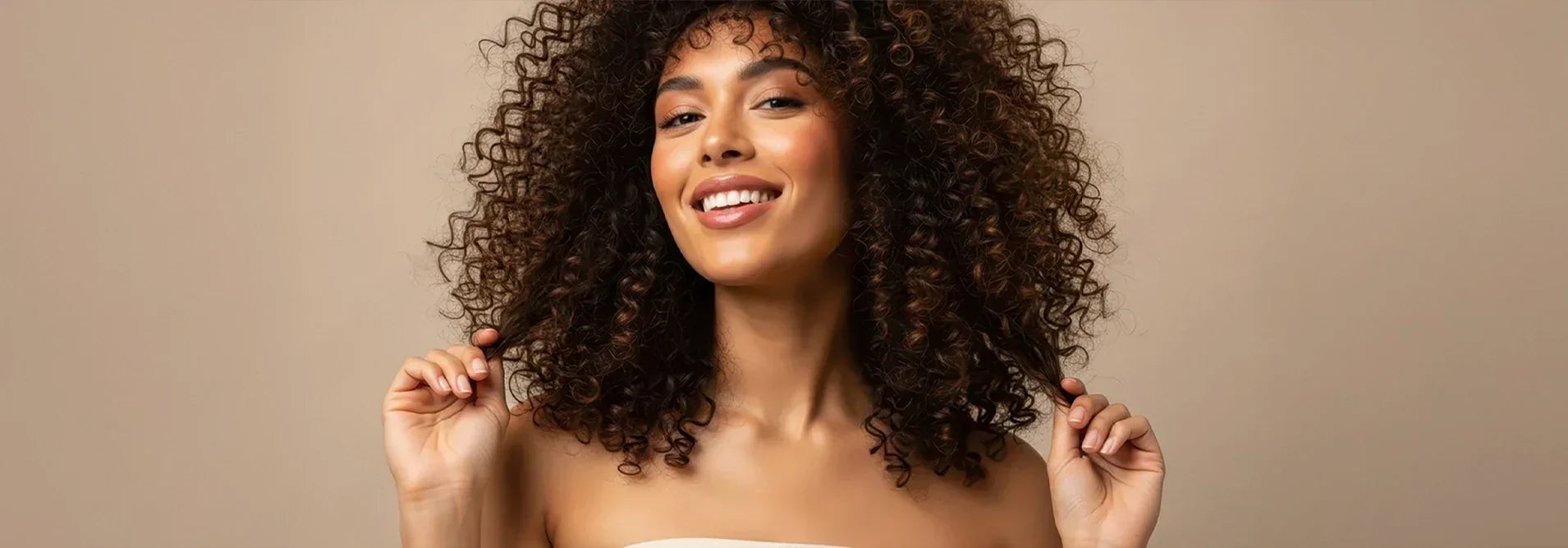







There's a question that comes up frequently in the curly hair world: why does a product work wonderfully for someone else, but for you, it leaves your hair heavy, shapeless, or without the results you expected?
Often, the answer isn't whether the product is good or bad. It's that it wasn't designed for your hair's actual needs.
And that's where two concepts come in that completely change how you understand your routine: porosity and thickness. Knowing them isn't about getting technical or making your life more complicated. It's quite the opposite: understanding your hair better to stop blindly experimenting.
Porosity is not a label; it's a clue about your hair's condition
There's a lot of talk about porosity as if it were a fixed category, but in practice, it's often closely related to the condition of the hair fiber. The more damaged the hair, the more open the cuticle tends to be, and the easier it is for it to lose moisture.
Therefore, understanding porosity isn't just for choosing products. It also helps you gauge the current state of your hair.
High porosity: when hair is more damaged
Hair with high porosity tends to absorb water and products very quickly, but it also loses them easily. This is common in hair that has been bleached, dyed frequently, permed, has fine gray hairs, or has undergone chemical processes that have opened the cuticle further.
It's often that hair that feels rougher, frizzes faster, frequently demands treatment, and improves significantly with good repair work.
In these cases, a routine that combines proteins, amino acids, hydration with good retention, and some nourishment to help seal the cuticle usually works best. The goal is not only to soften the hair but also to strengthen a weakened fiber.
Medium porosity: the most common point
This is probably the most common situation. The hair isn't severely damaged, but it's not untouched either. It has accumulated small daily damages: sun, moderate heat, dry brushing, inconsistency with masks, or an ill-suited routine.
It's the typical hair that isn't "bad," but it doesn't quite respond as well as it could. In these cases, a balanced routine usually works: good hydration, moderate proteins, and light oils that help without overwhelming.
The good news is that this type of hair usually improves significantly once it finds a consistent routine.
Low porosity: when hair is healthier
Low porosity is usually seen in minimally damaged hair with a fairly closed cuticle. It's common in children and in hair that has barely undergone chemical processes or significant aggressions.
Here, the hair doesn't usually need as much repair but rather a light and well-chosen routine. Regular hydration, few oils, and occasional proteins are usually sufficient. In fact, when formulas are too heavy, this type of hair gets overwhelmed faster and easily loses its movement.
For low porosity, less is often more.
Thickness is not the amount of hair you have
This is another point that causes a lot of confusion. Thickness doesn't refer to whether you have a lot or a little hair. It refers to the diameter of each hair fiber.
And understanding it is key because it determines how much load your hair can withstand.
A very simple way to gauge this at home is to compare several clean hairs with a sewing thread. If the hair is finer than the thread, we're talking about fine thickness. If it's quite similar, it would be medium thickness. And if it's thicker, we'd be looking at thick hair.
What changes depending on your hair's thickness
Fine hair usually appreciates lightweight formulas. When you overuse oils, butters, or very dense products, it gets weighed down faster and easily loses its shape.
Medium thickness is usually the most versatile. It typically tolerates many types of products well, provided the porosity is well understood.
Thick hair, on the other hand, usually accepts more nourishing and rich formulas better, because the fiber can withstand them more effectively and often needs them to stay flexible and beautiful.
The combination that truly matters
The key isn't to look at just one thing. It's to cross-reference both.
Fine hair with high porosity won't need the same as thick hair with low porosity. The first will need repair, but with lightweight formulas. The second will probably appreciate hydration and some nourishment, but without overdoing proteins. And medium hair with medium porosity usually responds very well to a fairly balanced routine.
That's the difference between buying based on general recommendations and choosing with discernment.
Why this changes how you approach your routine
When you understand your porosity and thickness, you stop looking for "the perfect product for everyone" and start looking for what works for you. And that greatly changes how you shop, how you combine products, and how you understand why your hair reacts the way it does.
It also makes it easier to navigate our ecosystem. If you're still unsure about your hair's condition, the porosity guide can help you identify it better. And if you want to go a step further, the porosity packs are specifically designed to make that initial success easier.
Additionally, if your hair is more wavy or you're looking for a lighter routine, the wavy hair section can help you filter better. And if you still have doubts, you can always rely on the product recommendation page to refine your choices.
The important idea
There is no one-size-fits-all perfect product. There is the product that fits your hair's actual needs.
Therefore, understanding porosity and thickness is not a technical detail. It is the foundation for moving away from trial and error, better caring for your hair, and getting your routine right from the start.